
Executive summary#
The analyzed sample named “paradise.exe” is a 32-bit windows excutable that encrypts everything on the host.The sample establish presistence via windows startup folder and disable windows defender by editing registry.
File Identification#
- Filename : paradise.exe
- File Size : 334 KB
- Architecture : PE32 (x86)
- Compiler Stamp : 2019-12-08 19:42:38
- MD5 : 9ac8c2482e25dab49befb711172924f7
- SHA-256 : c12b75f4b1bfcf41c45666f9a3801b735653c7ea61d14c3b700e60c035f55b32
- SHA-1 : dbc38594cd2e6ab7ae0f2ab7dfdb023d73e6c1c9
- BASE : 0x0400000
Static Analysis#
PE & Sections#
The sample has 5 sections
| Section | Size |
|---|---|
| .text | 15000 |
| .data | 2000 |
| .rsrc | 8000 |
| .py | 10000 |
| .py | 15000 |
Imports & Strings#
All imports are destroyed, No interesting strings either so it idicactes the malware is packed.
Dynamic Analysis#
When running the malware it asks for administration access,if we gave it the access it encrypts every thing in our pc and rename them and adds .tor as extenstion.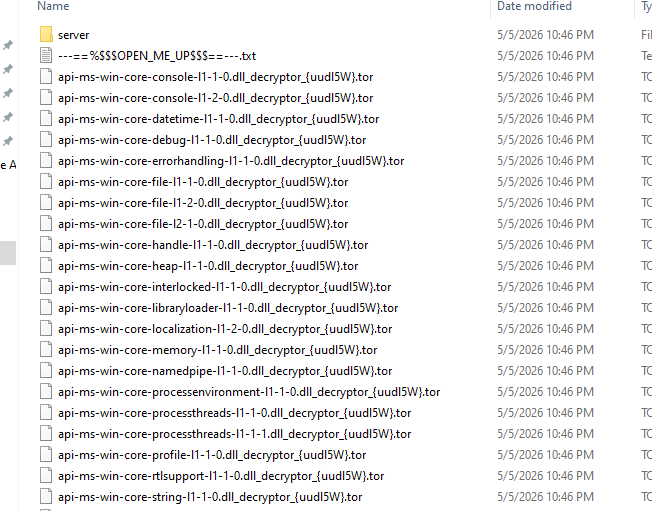
$==—.txt” in every folder.
if we opened “—==%
$==—.txt” it opens multiple windows of notepad and all displaying the same text
“WHAT HAPPENED! Your important files produced on this computer have been encrypted due a security problem. If you want to restore then write to the online chat.
Contact! Online chat: http://prt-recovery.support/chat/25-decryptor Your operator: decryptor Your personal ID: uudl5W
Enter your ID and e-mail in the chat that you would immediately answered.
Attention! Do not rename encrypted files. Do not try to decrypt your data using third party software, it may cause permanent data loss. Do not attempt to use the antivirus or uninstall the program. This will lead to your data loss and unrecoverable. Decoders of other users is not suitable to decrypt your files - encryption key is unique.”
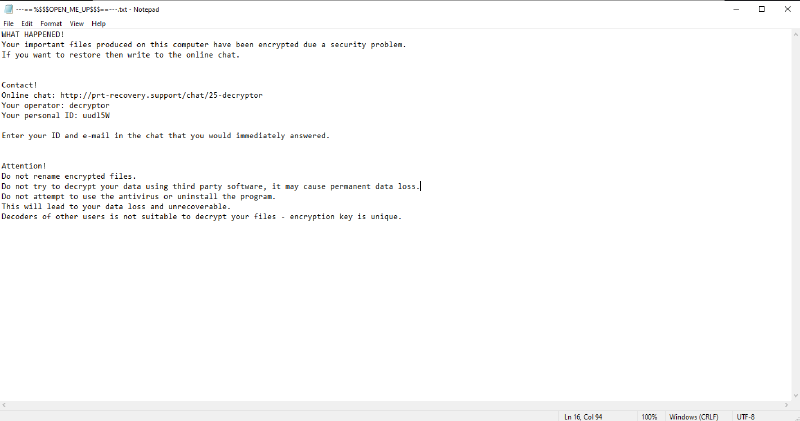
the personal ID changes everytime you run the malware.
The malware drops a file in the startup path “C:\Users\Malware\AppData\Roaming\Microsoft\Windows\Start Menu\Programs\Startup” it has a random name in my case it’s “qkHQv9K52orENSR8a2q.exe” with the same size probably a copy of the malware.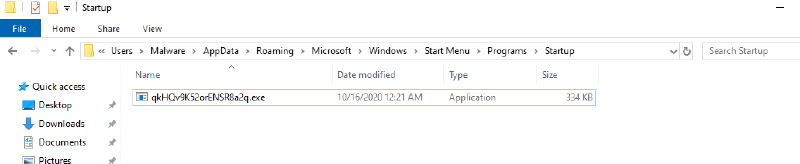
Reverse Engineering & Code Analysis#
When we open the code in ida we find nothing much as the malware is packed,there is a tale jump at the end of the start function at address 0x04040CC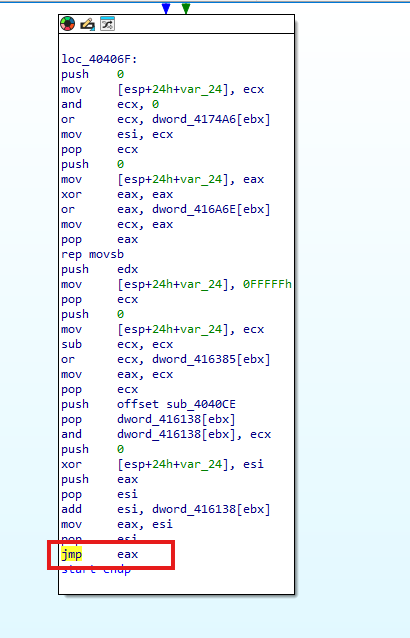
This subroutine rewrite the .txt in the original malware sample and that’s the real code.
after rewriting the the .text the code jumps to the sample again at address 0x04031E0
when we hit address 0x04031E0 the first subroutine call is loading libraries and storing apis in memory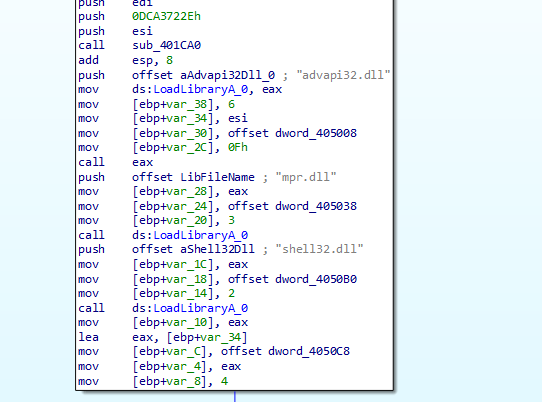
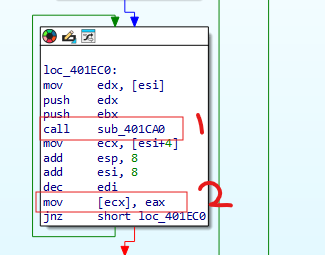
- 1- is for getting the apis
- 2- is for storing it in memory
then the malware calls a subroutine sub_401C10 it loads resource from memory turns out this resource is the public key of RSA 2048-bit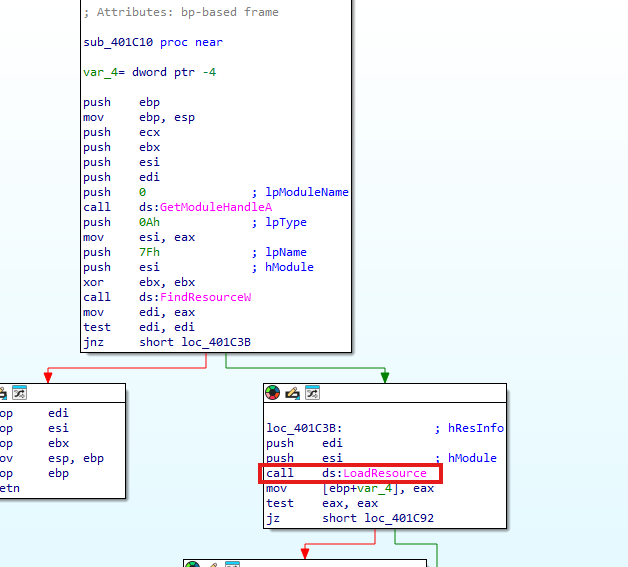
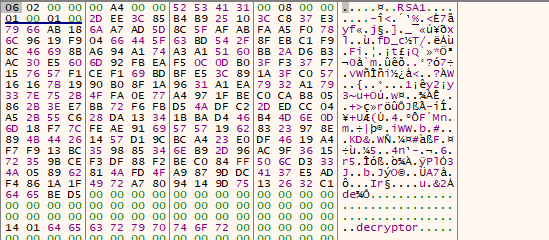
—–BEGIN PUBLIC KEY—–
MIIBIjANBgkqhkiG9w0BAQEFAAOCAQ8AMIIBCgKCAQEA1b5lZMEyJhN1nRSUgKdy
SR8ahvSt5TdB3J2HqU/9SoFiiQVKM9NsUP+EwL7yiN/zzps1chU2n6yWLbluNIWY
NbwT+fekGUbf4COkvJzRVxQmREuJjpcjg2IZV1dpka7+fPcYbQ1uTbRG1LobNBPa
KMZVK6UEzO0twt9K1fv2crvnPiuGBbjKwL4fl6R3DvpPK3V+M3mhMnnqoTGWGo+w
kBl7FhZXwD8aiTzlv71p8c7xV3YV9zfzP7ANDPXq+5JtYOUwrLPWKrtgUaGjdKGU
potpRoz5weuPL1S9Y19EZgT5GZZsePCl+quvX4xdradqGKtmeeM3yDwQJbm0hTzu
LQIDAQAB
—–END PUBLIC KEY—
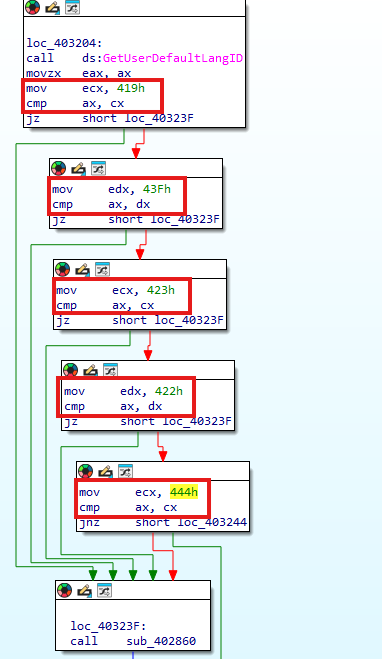
After this subroutine the malware gets the default language and compare it to the following languages
| Hex Code | Decimal | Language | Locale Name |
|---|---|---|---|
| 43Fh | 1087 | Kazakh | kk-KZ |
| 419h | 1049 | Russian | ru-RU |
| 423h | 1059 | Belarusian | be-BY |
| 422h | 1058 | Ukrainian | uk-UA |
| 444h | 1092 | Tatar | tt-RU |
 | |||
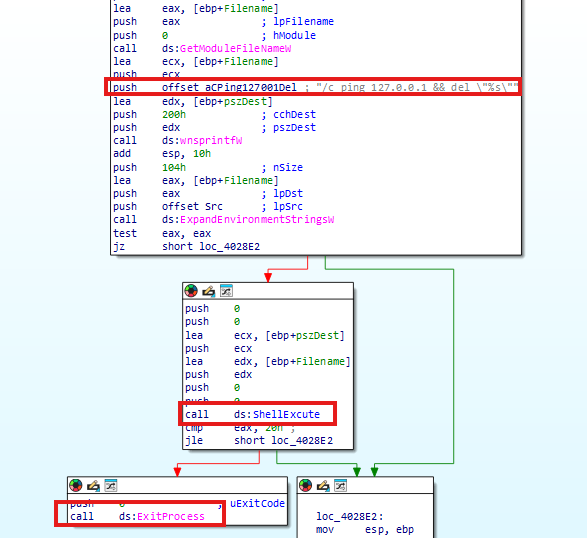
| if any of these languages it enters sub_402860 which deletes the malware and exits the process | |||
 | |||
 | |||
| If not it enters sub_402E60 |
sub_402E60#
It is the core of the malware first thing in this subroutine that it calls another function sub_4028F0
sub_4028F0#
in this function first it checks for the process privilage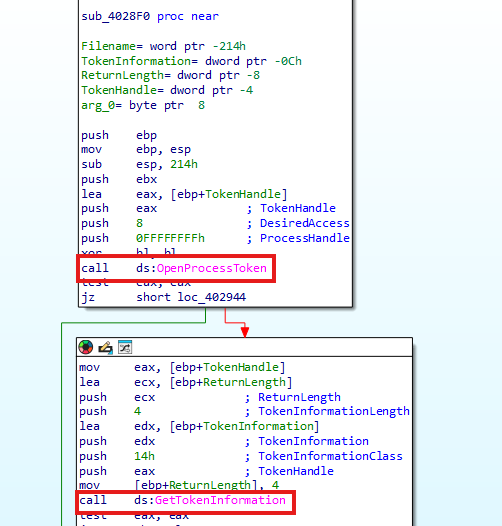
if it has no administration privilage it run it asks to run itself as administration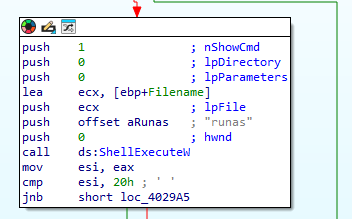
after sub_4028F0 we go back to sub_402E60 it’s intializing RSA using CryptAcquireContextW, then the function calls sub_401780.
sub_401780#
The function starts by asking the OS for Crypto keys using CryptGenKey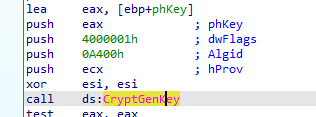
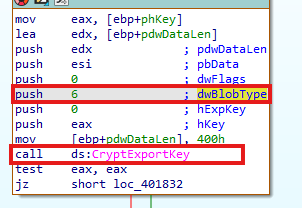
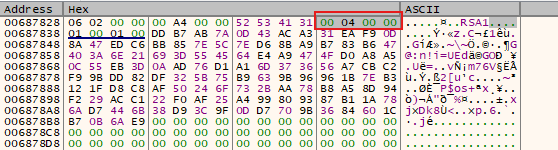
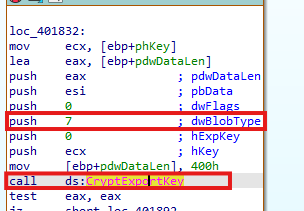
So the malware uses RSA 1024-bit to encrypt files and then it encrypts the private key with the hardcoded RSA 2048-bit.
We can get the private key of the RSA 1024-bit but it’s unique for every host so if we got the key we can decrypt only one host.
To decrypt all hosts we should get the private key of RSA 2048-bit and it’s only with the author not in the binary.
Then the malware imports first the public and private key of RSA 1024-bit into CSP.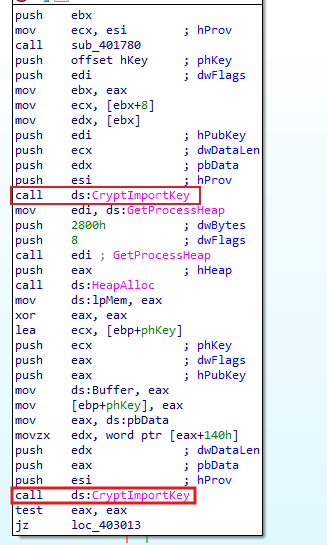
Then the malware uses CryptEncrypt to encrypts the private key of RSA 1024-bit using the public key of RSA 2048-bit.
Next the malware disable windows defender real-time scanning and core services by editing registry “SOFTWARE\Policies\Microsoft\Windows Defender” and set it to “DisableAntiSpyware”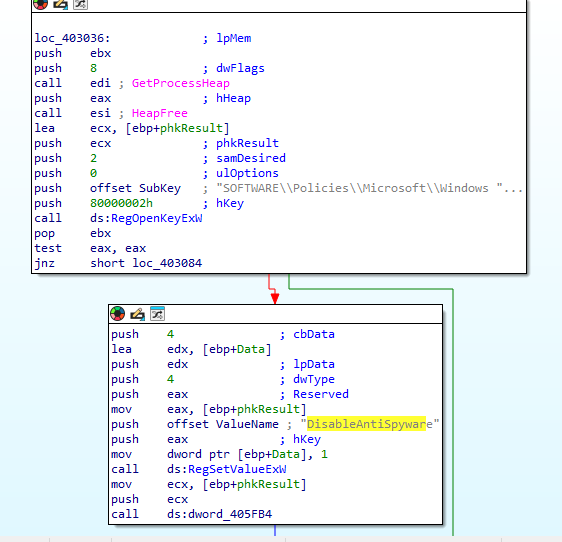
Then the malware deletes any snapshot or shadow copy the host has by excuting this "\sysnative\vssadmin.exe delete shadows /all /quiet"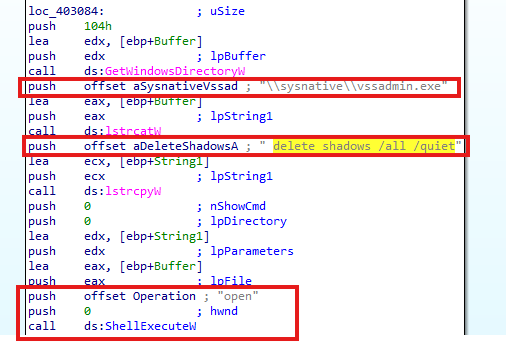
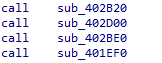
1- sub_402B20#
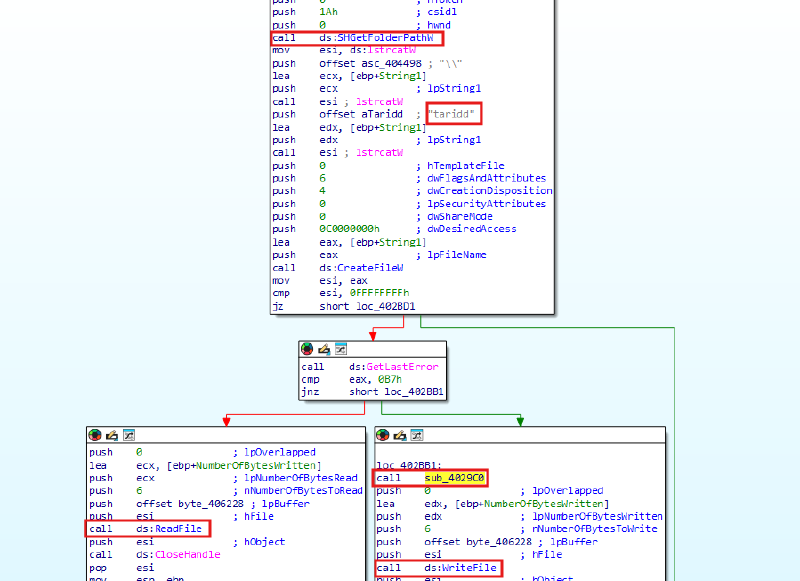
2- sub_402D00#
The secound one is to store the message on the .txt file we talked about earlier and to make your id for contact operator.
3- sub_402BE0#
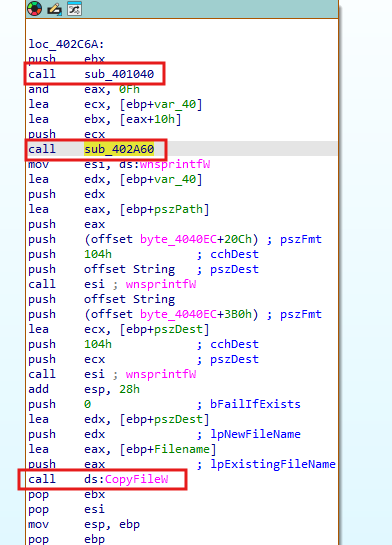
4- sub_401EF0#
The malware first see the process using Process32NextW and compare it with a list of processes
| mysql | IBM | bes10 | black | sql | store.exe | vee | postg | sage |
|---|
if it is one of the process listed the process will be terminated using TerminateProcess.
And it checks for the services under the same name if it found one it will call ControlService with SERVICE_CONTROL_STOP as dwControl.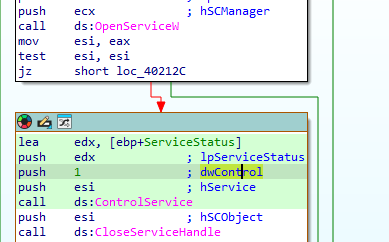
Then the malware call SHGetFolderPathW to get the path to the Desktop then it calls sub_402720
sub_402720#
The malware here gets all drives and get the type of it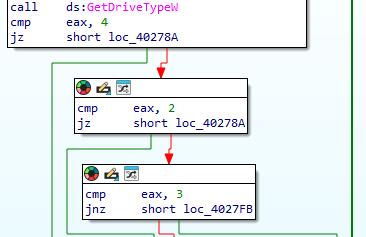
The malware then make thread that has StartAddress which is the encryption function at address 0x0402470 then it increaments EDI,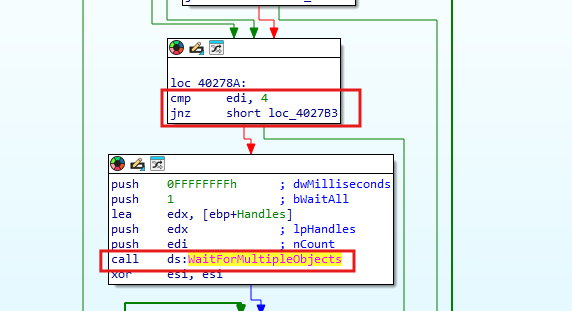
The maximum number of threads per time is 4 if there are 4 threads the malware will wait using WaitForMultipleObjects.
StartAddress at address 0x0402470#
The Malware first upload 5 strings into an array Windows,$Recycle.bin,System Volume Information,Program Files,Program Files (x86) then it takes the thread parameter which will be the drive the thread is working on and append * to it using wnsprintfW then the malware calls FindFirstFileW to get the first file of the drive.
The malware then go into do while loop each time it compares the file found by FindNextFileW with the five strings we found earlier, if it’s one of the 5 strings it skips the encryption so the malware doesn’t encrypt the core system.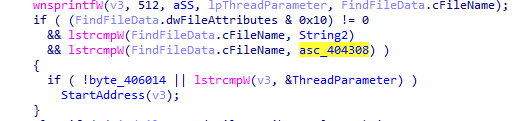
If the malware found a file it checks it’s attribute and checks if the file is already encrypted using it’s own unique extension or the file is —==%$$$OPEN_ME_UP$$$==—.txt or taridd if it’s one of those it skips the encryption,if not it calls sub_402190 which is the core encryption.
sub_402190#
The function starts by checking if the file is already encrypted using extention,then it opens the file with READ\WRITE access.
Then it calls sub_401150 to generate custom symmetric key and then the malware encrypt that key using the RSA 1024-bit key by CryptEncrypt.
Then the malware reads the first 10KB of the file using ReadFile and calls sub_401680 to apply the encryption.
Then it calls WriteFile to write the first 10KB of the file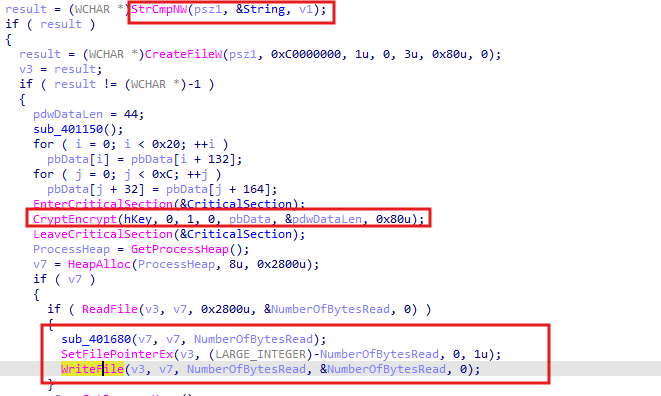
Then it writes it’s configurations , RSA key and mark to the end of the file and then it renames the file with it’s extension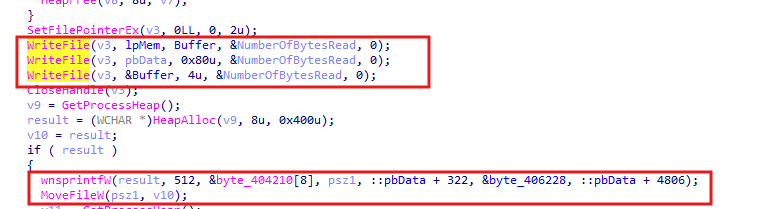
After sub_402190 finishes the malware go back to StartAddress to call sub_4023C0 which write —==%$$$OPEN_ME_UP$$$==—.txt to the folder.
Then the malware calls sub_401A80 and pass a URL https://iplogger.org/1AsWy7.
sub_401A80#
This function first calls sub_4018C0 and pass the URL to it to split the url into iplogger.org and 1AsWy7 then it calls InternetOpenW and then calls InternetConnectW with lpszServerName as iplogger.org then it opens GET request and send it to 1AsWy7 this makes the attacker stores data about the infected machines.
IoCs#
| Type | Indicator | Description |
|---|---|---|
| Hash MD5 | 9ac8c2482e25dab49befb711172924f7 | Original File Hash |
| File path | C:\Users\User\AppData\Roaming\Microsoft\Windows\Start Menu\Programs\Startup\ | Drop a copy of itself in the startup folder under a random name |
| Registry | SOFTWARE\Policies\Microsoft\Windows Defender | Disable Windows defender |
| File dropped | —==%$$$OPEN_ME_UP$$$==—.txt | Drops this file after encryption as instructions for contacting the author |
| Strings | Windows,$Recycle.bin,System Volume Information,Program Files,Program Files (x86) | Malware avoid to encrypts these |
| URL | https://iplogger.org/1AsWy7 | Attacker uses this to know the infected machines |
| Request type | GET | Attacker make a GET request |